
XEO Experience & Engine Optimization (includes SEO, AEO, GEO, SXO)
DO SEARCH ENGINES & AI UNDERSTAND YOUR WEBSITE’S CONTENT?
Introducing XEO (The Unifying Framework)
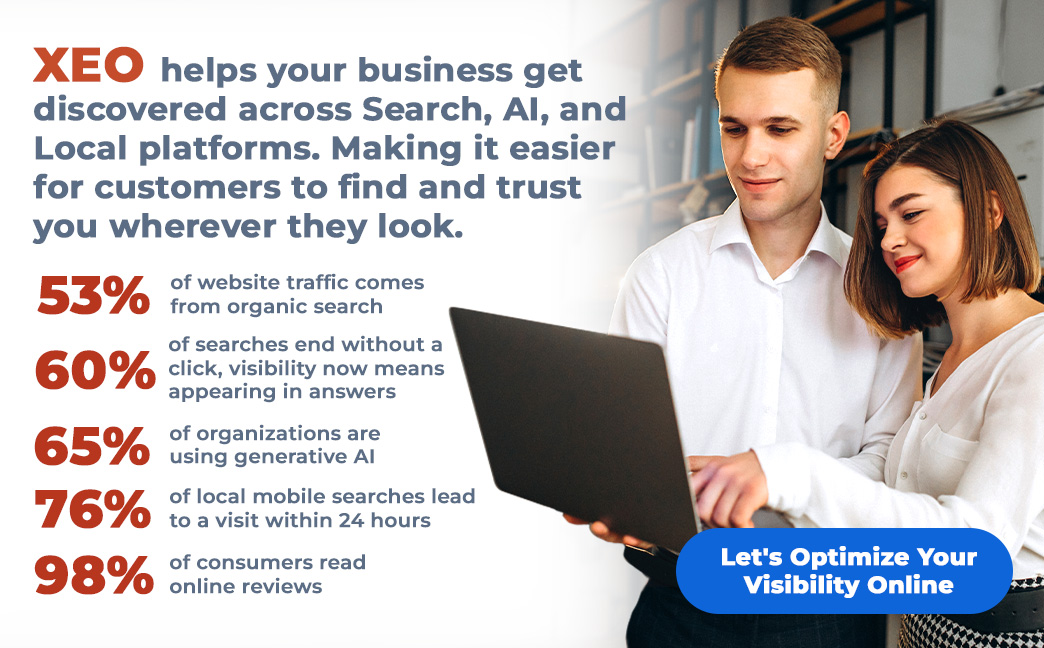
With artificial intelligence reshaping how people discover information, optimization has expanded beyond traditional search engines. This has led to XEO (Experience & Engine Optimization) — a holistic approach to optimizing content so it performs across all discovery engines, human and AI alike.
XEO encompasses SEO, AEO, GEO, and SXO, aligning technical signals, content clarity, machine readability, and user experience into a single strategy.
Definitions: How Each Fits Together
- XEO (Experience & Engine Optimization)
A unified optimization strategy that ensures your content is discoverable, understandable, trusted, and usable across search engines, answer engines, generative AI platforms, and real human experiences. XEO is the umbrella under which all modern search optimizations operate.- SEO (Search Engine Optimization)
Optimize your site so traditional search engines can crawl, understand, rank, and drive organic traffic from search engine results pages (SERPs). - AEO (Answer Engine Optimization)
Structure content to be selected as the direct answer by answer engines such as featured snippets, voice assistants, and AI chat interfaces. Even when no click occurs, the goal is to be the cited or spoken source. - GEO (Generative Engine Optimization)
Refine content so it is selected, summarized, or cited by generative AI systems such as AI Overviews, ChatGPT, Perplexity, and other LLM-powered search experiences. - SXO (Search Experience Optimization)
Combine SEO with user experience (UX) optimization to ensure that once users arrive from search or AI discovery, they quickly find what they need, trust the content, and take meaningful action.
- SEO (Search Engine Optimization)
________________
SEO gets you found.
AEO gets you answered.
GEO gets you cited.
SXO gets you chosen.
XEO makes it all work together.
Why Should XEO Be Used?
Search has evolved. Your visibility strategy should evolve with it.
Traditional SEO focused on rankings. XEO focuses on discoverability across search engines, maps, local listings, and AI driven results. It ensures your business is positioned where real buying decisions happen.
Visibility Beyond Rankings
People search in multiple ways. Google. Maps. Voice search. AI generated answers.
XEO aligns your website, content, and digital footprint so your business appears across these environments, not just in one list of blue links.
Stronger Authority Signals
Search engines and AI systems look for structured data, topical depth, and consistent entity signals.
XEO strengthens your authority by organizing content, implementing schema markup, and reinforcing your core services with clarity and structure.
Sustainable Growth
Paid advertising stops when budget stops.
XEO builds long term visibility that compounds over time, supporting consistent traffic and qualified inquiries.
Competitive Advantage
XEO positions your business to be found in a modern search environment.
It is not about chasing algorithms. It is about building structured visibility that supports growth.
AI search traffic is growing rapidly and may surpass traditional search traffic by 2028, which means being visible in newer AI-powered search environments will be a critical part of brand discovery going forward.
– SemRUSH.com
Search and AI Readiness
Visibility today is not about inserting keywords.
It is about structuring your digital presence so search engines and AI systems clearly understand your authority, relevance, and service focus.
Content Architecture & Topic Authority
Modern search evaluates depth and structure, not keyword density.
We organize your content into focused service clusters with clear internal linking and semantic relationships.
This builds authority in your core areas and strengthens visibility across search engines, maps, and AI generated results.
Structured Data and Business Expertise
Search engines and AI platforms rely on structured information and your knowledge.
We implement schema markup, reinforce business entities, and clarify service relationships so your company is properly categorized and surfaced.
If your business is not clearly defined, it will not be confidently displayed.
Technical Performance and Dsicoverability
Technical health still matters, but now it supports discoverability across multiple environments.
We optimize:
Crawl paths
Index health
Mobile performance
Core Web Vitals
Structured data validation
Your website must be accessible and understandable to both users and machines.
Conversion Aligned Visibility
Traffic alone does not drive growth.
We align search visibility with clear conversion pathways so increased exposure results in qualified inquiries and measurable business outcomes.
What We Optimize
Search intent alignment
Structured content and business clarity
Technical performance and crawl health
Site architecture and authority
Conversions and the structure to support it
KEY XEO FACTORS
XEO: Frequently Asked Questions (FAQs)
What is On-Page SEO vs. XEO?
On-Page SEO (also called on-site SEO) is the practice of optimizing the content, structure, and technical elements of individual web pages so they can be understood, evaluated, and ranked by search engines. Within modern optimization frameworks, on-page SEO is a core execution layer of XEO, supporting visibility across traditional search engines, AI-driven answer engines, and generative search platforms.
How do I show up for Voice services like Alexa and Siri?
How Voice Gets Answers
Voice assistants don’t “search” like humans. They:
- Pull from structured databases
- Pull from knowledge graphs
- Pull from featured snippets
- Pull from high-authority, clearly structured content
- Pull from local listings
- Pull from reviews
If your data isn’t structured and authoritative, you won’t be selected.
Voice assistants want:
- Clear entity recognition
- Structured data
- Direct answers
- Strong reviews
- Consistent business data
- Authority signals
This is AEO + Local SEO + GEO combined.
Ready to Review Your Visibility?
If you have a solid designed website but it’s not showing up in results, it’s time to get an assessment of your XEO strategy.
Let’s determine what makes sense for your business.
Marketing is Never About Just 1 Thing
Drive Traffic to Your Assets Online
Growth requires layering tactics from a solid foundation and infrustructure to optimization and then accelerating those pathways to your next customer.

Digital Advertising

Content Marketing
Content marketing is the strategic creation and distribution of relevant and valuable content to attract, engage, and retain a target audience, ultimately driving profitable customer actions.
Learn More